Klara Simmons · 25 November 2026
Decoding Natural Lattice Designs in Coral for Improving Flexibility in Subsea Pipeline Inspection Tools
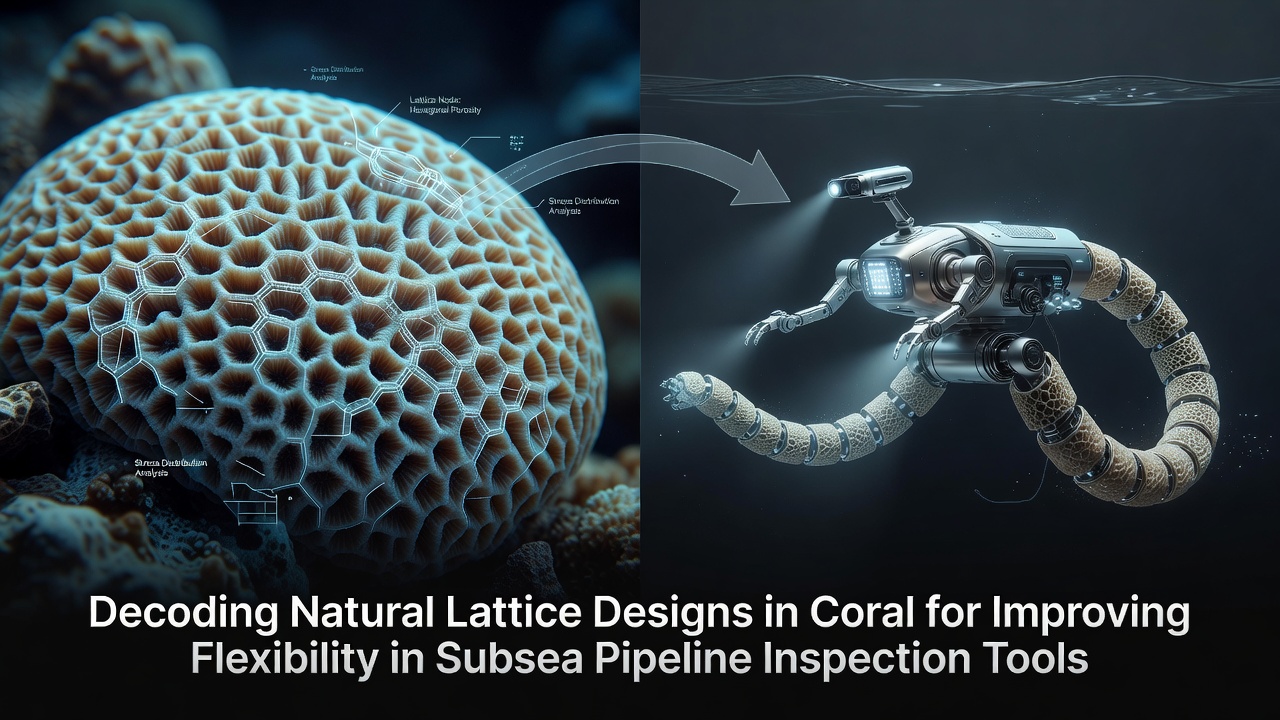
Marine biologists and materials engineers have analyzed the skeletal formations of various coral species to identify lattice patterns that combine rigidity with adaptive bending under ocean currents, and these observations now inform the design of inspection devices used in subsea pipeline maintenance. Coral skeletons often feature repeating hexagonal and rhombic cells connected by thin trabeculae that allow localized flex without fracture, properties documented through micro-CT scans conducted across reef sites in the Indo-Pacific region.
Structural Features of Coral Lattices
Studies from institutions including the Australian Institute of Marine Science have mapped how species such as Acropora and Porites develop three-dimensional networks that balance compressive strength against tensile forces from wave action. Data collected between 2023 and 2025 show that these lattices maintain porosity levels between 40 and 60 percent while distributing mechanical loads across multiple pathways, reducing stress concentrations at any single point. Engineers have replicated simplified versions of these networks using additive manufacturing techniques with polymers and metal alloys, producing prototypes that withstand repeated bending cycles at depths exceeding 200 meters.
One research team at the University of Queensland extracted geometric parameters from coral samples and translated them into parametric models for robotic components. The resulting arm segments incorporated variable wall thicknesses and node placements that mirror trabecular spacing observed in healthy reef colonies. Laboratory tests demonstrated that these segments achieved 35 percent greater deflection range before permanent deformation compared with conventional cylindrical designs of equivalent mass.
Application to Subsea Pipeline Inspection
Subsea pipelines transporting oil, gas, and increasingly hydrogen require regular inspection for corrosion, cracks, and sediment accumulation, tasks performed by remotely operated vehicles equipped with cameras, ultrasonic sensors, and manipulators. Traditional rigid inspection arms often encounter difficulties when pipelines rest on uneven seabeds or pass through narrow spool pieces, leading to increased mission times and higher equipment wear. Lattice-inspired flex joints address these constraints by permitting multi-axis movement while preserving torsional stiffness needed for precise sensor positioning.
Field trials conducted off the northwest coast of Australia in 2025 integrated coral-derived lattice modules into crawler-type inspection platforms. The modules allowed the vehicle to negotiate 90-degree bends with radii under 1.5 meters without losing contact pressure on the pipe surface. Operators reported that sensor data quality improved because the flexible sections maintained consistent alignment during transit, a result attributed to the even load distribution inherent in the replicated lattice geometry.
Material and Manufacturing Developments
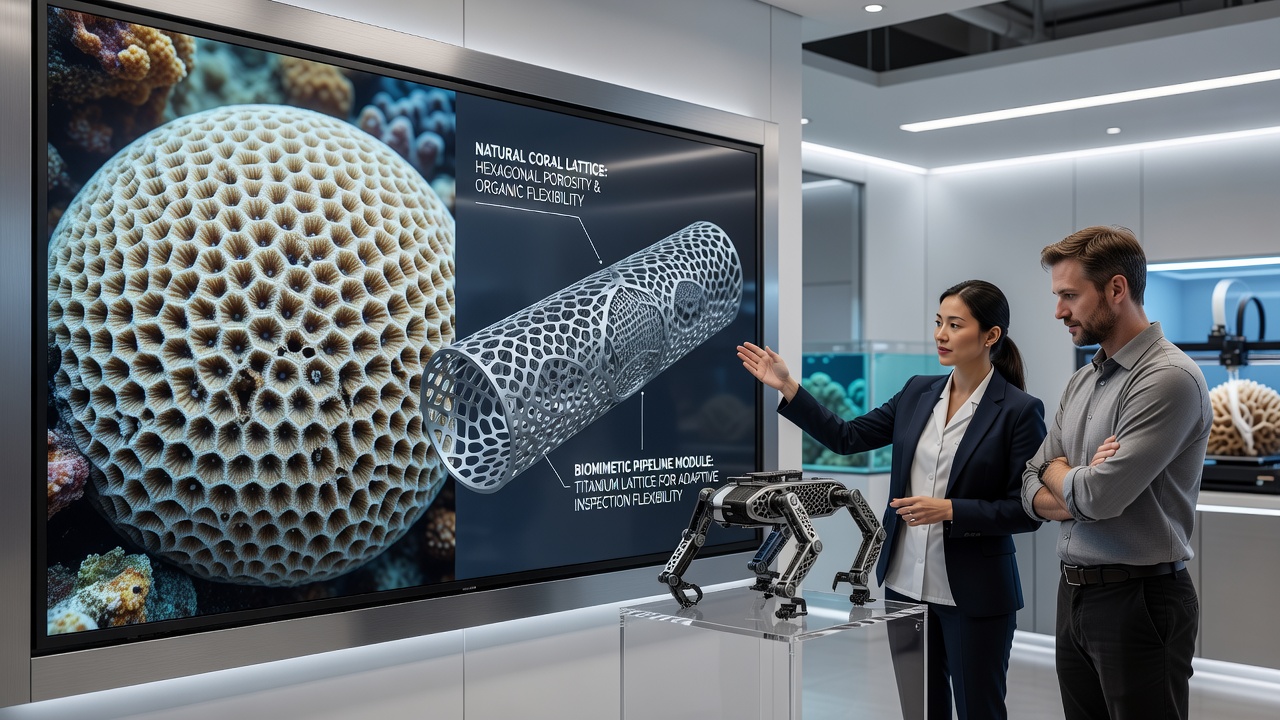
Researchers have explored several fabrication routes to scale lattice production for industrial use. Electron beam melting of titanium alloys yields high-strength components suitable for deep-water service, while fused deposition modeling with carbon-fiber-reinforced thermoplastics offers lower-cost options for shallower deployments. A 2024 report from the National Oceanography Centre in the United Kingdom detailed fatigue testing of lattice prototypes subjected to 10,000 bending cycles at simulated pressures equivalent to 300 meters depth, confirming retention of at least 92 percent of initial stiffness.
Additional work at the Technical University of Denmark has focused on hybrid lattices that combine rigid coral-inspired nodes with elastomeric ligaments, enabling passive shape recovery after deformation. These hybrids reduce the need for active actuators in certain inspection scenarios, lowering power consumption and overall system weight. Integration with existing pipeline inspection gauges has proceeded through modular adapters that attach lattice sections to standard sensor sleds without requiring complete redesign of the vehicle chassis.
Research Timeline and Future Directions
Collaborative projects scheduled for November 2026 aim to deploy full-scale lattice-equipped inspection systems on active export pipelines in the North Sea and the Timor Sea simultaneously. These missions will collect comparative performance data against legacy rigid tools under identical environmental conditions, including currents up to 1.2 meters per second and temperatures ranging from 4 to 28 degrees Celsius. Preliminary modeling indicates that the new designs could reduce inspection cycle times by 18 to 25 percent through improved maneuverability.
Further studies examine how coral lattice principles might extend to larger-diameter pipes and flexible risers where dynamic motion from surface vessels adds cyclic loading. Computational fluid dynamics simulations performed by teams at Memorial University in Canada incorporate lattice porosity effects on hydrodynamic drag, guiding refinements that maintain inspection accuracy while minimizing entanglement risks with marine growth or debris.
Conclusion
Observations of natural coral architectures continue to supply geometric and mechanical insights that translate directly into enhanced flexibility for subsea pipeline inspection equipment. Ongoing trials and material advancements demonstrate measurable gains in operational range and durability, supported by quantitative data from multiple ocean basins. As fabrication methods mature, these biomimetic approaches are expected to integrate more broadly into offshore inspection fleets across global energy infrastructure networks.